


A Car with a Self-Contained Badge: Benefits, Costs, Points of Contact
Discover New Zealand cheaply and comfortably.
Overview
- Intro
- Step 1 - What Does Self-Contained Mean?
- Step 2 - Is the Self-Contained Badge Worth It?
- Step 3 - What Does the Self-Contained Certificate Look Like?
- Step 4 - Where Can I Get the Certificate?
- Miscellaneous - Rules of Conduct
- Miscellaneous - Background
- Miscellaneous - I Need Help
- Frequently Asked Questions

Nils (Team KiwiQuest)
If you’ve already delved into the car search in New Zealand, you’ve probably stumbled upon the term “self-contained”. It’s a special certification for campervans that lets you camp for free almost anywhere in New Zealand without worry.
This is practical because you won’t constantly be tied to expensive campsites, allowing the badge cost to quickly pay itself off. It’s also extremely helpful when you sell your car later on.
So hold on tight you beautiful lama! Here’s everything you need to know! Ready? Go!
Intro

Saving Money While You Sleep...
We found out the hard way in New Zealand how not to do it. We explored New Zealand in a rickety Toyota Hilux Surf that had a mattress in the back, but that’s where the luxury ended.
We quickly discovered that traveling with a non-self-contained vehicle is very costly. Wherever we went, Freedom Camping sites were mostly off-limits to us. So we had to resort to expensive campsites, were much less flexible, and had less time to focus on the wonderful nature.
Add to that constantly hearing other backpackers save money night after night with free Freedom Camping didn’t make it any easier.
We’ll definitely be smarter next time!
Step 1 - What Does Self-Contained Mean?
Self-contained means nothing more than "independent" and refers to a vehicle equipped in such a way that you leave no waste while camping. The required equipment for the badge includes:
- Toilet
- Sink
- Wastewater tank
- Freshwater tank
- Trash bin with lid
Regarding Fresh and Waste Water
To be classified as self-contained, your vehicle must be able to hold fresh and waste water for at least three days (4 liters per day, per person) before you have to reach a disposal station. Not easy fitting all these into a vehicle, especially smaller ones.
Okay, so much for that. But is it really worth it? The only way to find out is: Let’s calculate!
Step 2 - Is the Self-Contained Badge Worth It?
The biggest advantage with the badge is in camping, as in many places you can only use free sites with a self-contained vehicle. Especially in regions managed by the Department of Conservation (DOC), Freedom Camping is allowed (with few exceptions).
User question:
How do I recognize Freedom Camping sites?
User question:
Where can I find Freedom Camping sites?
How much does the Self-Contained Badge Cost?
Unfortunately, the cost varies between providers and is different for each vehicle. We’ve looked around a bit and would suggest that you can expect roughly 300 – 500 euros for the conversions.
How much do you save with the Self-Contained Badge?
In general, you save on overnight stays with the badge, as you're not tied to campsites (around 5 - 15 euros/night). To find out whether the investment is worth it depends on how long you want to travel. So you don't have to do the calculations yourself, we've built a small calculator for you here.
Super-Top-Class-Service provided by: The mighty Team KiwiQuest!
Hope this helps! :-)
Step 3 - What Does the Self-Contained Certificate Look Like?
Good to know: there are both the green and the blue self-contained certificates. The blue self-contained certificate is no longer issued, as the regulations around self-containment in New Zealand were tightened as of December 2023.
The Blue Self-Contained Certificate
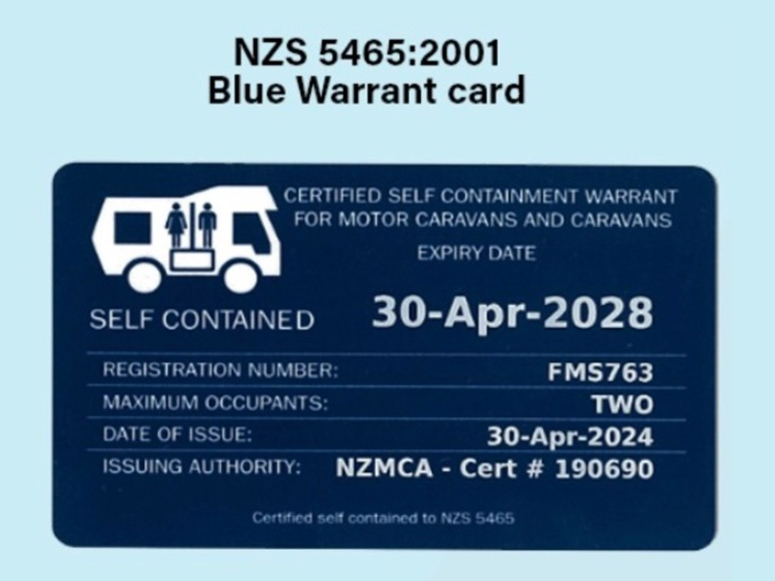 The blue Self-Contained badge is the old seal. It remains valid until December 7, 2027 unless it expires earlier. After expiration, you must apply for the green badge.
The Green Self-Contained Certificate
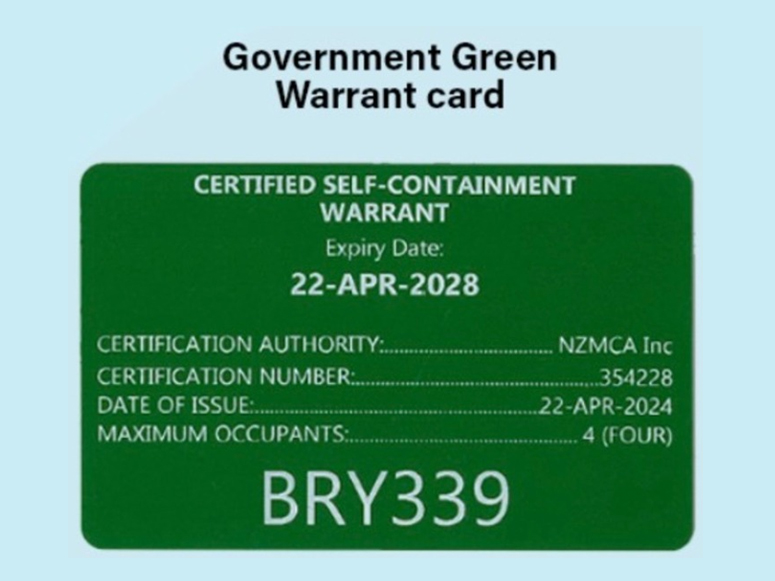 The green Self-Contained badge is the new seal. Since December 7, 2023, only the green certificate is issued. It comes with stricter regulations.
User question:
Where can I find my Self-Contained Certificate?
User question:
Buying a Camper with Self-Contained Badge? Where?
Step 4 - Where Can I Get the Certificate?
Many providers generally offer cars with a self-contained badge. In our offer for car purchase, we also work only with partners who offer the badge. Nevertheless, here is another overview:
Car Dealerships
If you buy a campervan from an official dealer or rental, you usually get the certificate automatically. It's different if you bid on a privately converted vehicle or decide to convert one yourself.
Mechanics
The self-contained certificate can be issued by any registered plumber or water installer. Your car must be thoroughly examined and meet specific requirements.
Requirements
The blue sticker is only given if your campervan complies with the NZS 5465 regulations and poses only a minimal risk to the environment and others' health as well as your own.
Reward
Good so far. As further support, here's also the following:
Miscellaneous - Rules of Conduct
Even though you're a lot more flexible with a self-contained campervan, you should definitely stick to the following rules. Because if you overlook the following, you'll still pay about 100 euros in fines despite the badge:
- overnight at 'self-contained only' places without an on-board toilet
- refuse to leave the area despite being asked
- park/overnight in unauthorized places
- deliberately damage the environment while camping
- refuse to provide your information to an officer
- leave waste behind
Note:
Up to $5000 Fine You Pay
Note:
Up to $10,000 Fine You Pay
Miscellaneous - Background
New Zealand often calls upon its green image and promotes itself as pure nature. Unfortunately, real life often looks different. In recent years, tourists have significantly contributed to polluting entire stretches of land, beaches, and other popular destinations with waste and feces.
As a result, the rules around camping in New Zealand have been extremely tightened. In many places, parking spots are restricted to vehicles with a self-contained certification. If you still approach these places with a normal car or campervan and get caught overnighting, you’ll pay about 100 euros in fines.
Miscellaneous - I Need Help
If the whole self-contained topic is too complex, you can of course rely on our recommendations. We're happy if our work benefits someone and hopefully makes your start a little easier. Alternatively, there's our checklist for car buying available for download.
The most popular concept for camper purchase in New Zealand is back
Frequently Asked Questions
What other KiwiQuesters wanted to know...
User question:
How long does it take to get the certificate?
User question:
And how long is the certificate valid?
User question:
What does the inspection cost?
Camper Purchase with Buyback Guarantee: The Insider Tip for New Zealand
The most popular concept for camper purchase in New Zealand is back
Reserve SpotWhat else is there?







We wish you an amazing adventure!
Welcome to Team KiwiQuest!
Team KiwiQuest
